

Finding a plumber is easy. Finding a reliable plumber you can trust inside your home is much harder.
A leaking tap, blocked drain, broken pipe, water-pressure problem or geyser connection can quickly become an urgent issue. In these situations, most people search for a plumber nearby and choose the first available option.
But availability alone doesn’t mean a professional is reliable.
Before hiring a plumber, it is worth checking their experience, skills, reviews, service area, pricing, availability and, where available, identity or background verification.
This guide explains what to look for when choosing a plumber near you and how to avoid common problems when hiring local plumbing professionals.
Quick Answer: How Do You Find a Reliable Plumber Near You?
A reliable plumber should have relevant experience, good customer feedback, clear communication and reasonable pricing. Depending on the type of work, you may also want to check identity verification, previous work, service coverage and whether the professional provides any service guarantee.
A simple checklist is:
- Identify the plumbing problem.
- Search for plumbers who serve your area.
- Check their experience and relevant skills.
- Read genuine customer reviews.
- Look for available verification information.
- Ask about the estimated cost.
- Confirm availability before the visit.
- Discuss the work before allowing repairs.
- Keep a record of the agreed price and work.
- Review the professional after the service.
Why Choosing the Right Plumber Matters
Plumbing work may look simple, but incorrect repairs can create bigger problems.
For example, a small leak that is repaired incorrectly can eventually cause water damage. A poorly installed pipe connection can start leaking again. Incorrect work around water heaters or other equipment can also create safety concerns.
A good plumber doesn’t simply fix the visible problem. They should be able to understand the underlying issue and recommend an appropriate solution.
The right professional can help you:
- Diagnose the actual plumbing problem
- Prevent repeated leaks
- Reduce unnecessary repair costs
- Complete work safely
- Recommend suitable replacement parts
- Explain what needs to be repaired
- Complete the job within a reasonable timeframe
10 Things to Check Before Hiring a Plumber
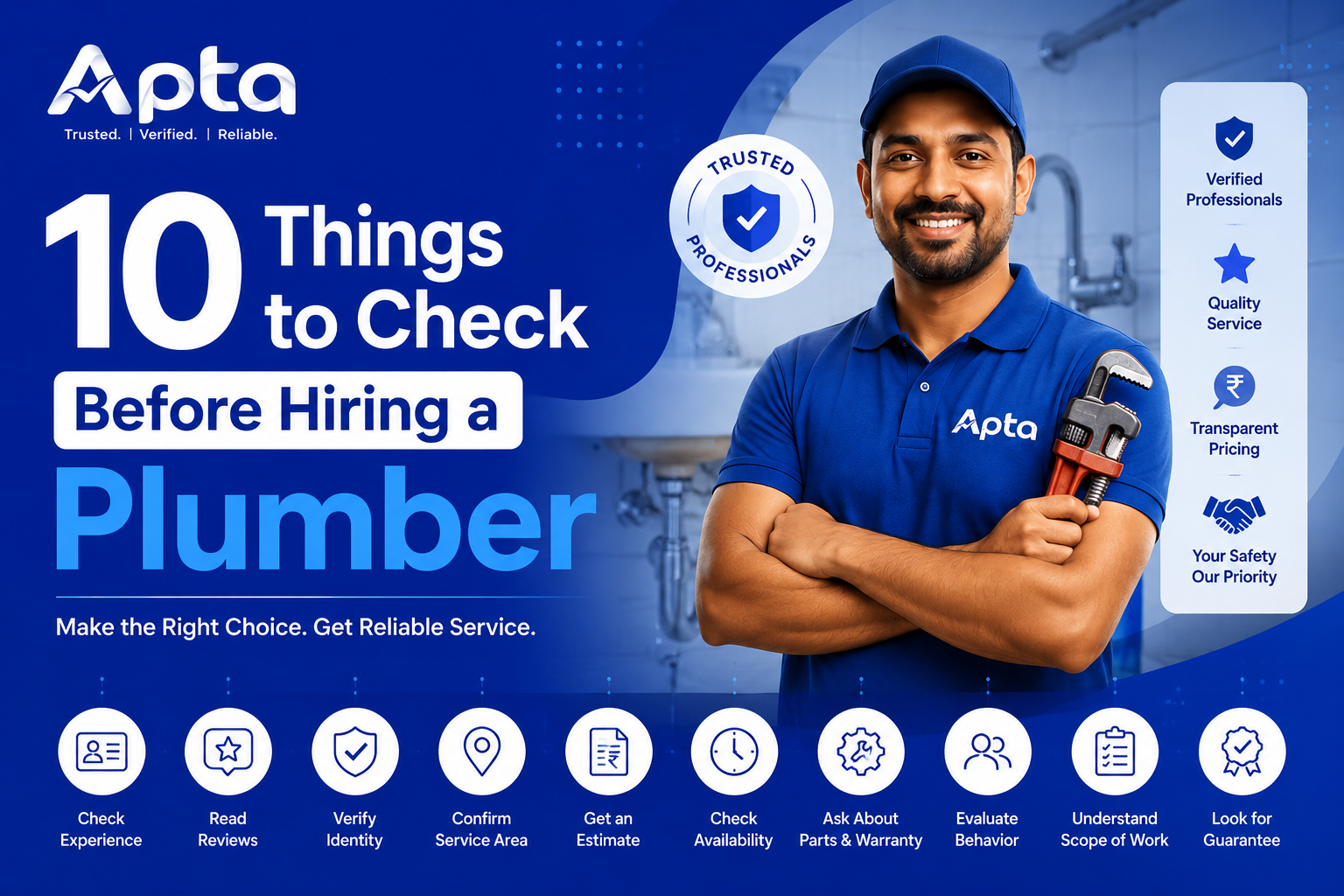
1. Check Relevant Experience
Experience is one of the first things to consider.
A plumber who regularly handles residential plumbing may be suitable for leaking taps, bathroom fittings, blocked drains and water-supply problems.
However, more specialized work may require someone with specific experience.
For example:
- Bathroom plumbing
- Kitchen plumbing
- Water-tank connections
- Pipe installation
- Drainage problems
- Water-pressure problems
- Geyser plumbing connections
- New construction plumbing
- Commercial plumbing
- Emergency plumbing
Instead of simply asking, “Are you a plumber?”, ask whether the professional has handled your specific type of problem before.
2. Read Customer Reviews
Reviews can help you understand what previous customers experienced.
Don’t look only at the star rating. Read the actual reviews.
Pay attention to comments about:
- Quality of work
- Professional behaviour
- Punctuality
- Pricing
- Communication
- Cleanliness
- Whether the problem was actually resolved
- Whether the customer would hire the professional again
A plumber with a slightly lower rating but many detailed and recent reviews may sometimes provide more useful information than someone with a perfect rating and very few reviews.
Look for patterns
One negative review doesn’t necessarily mean that a plumber is unreliable.
Instead, look for repeated patterns.
If multiple customers mention the same issue, such as unexpected charges or repeated repair problems, it may deserve your attention.
3. Check Identity and Verification Information
When a professional is entering your home, trust matters.
Where available, check whether the platform or service provider profile provides information such as:
- Identity verification
- Phone verification
- Selfie verification
- Address verification
- Background or police verification
- Professional certificates
- Business information
Not every plumber will have every type of verification, and the requirements can differ depending on the service.
The important thing is to understand what has actually been verified rather than assuming that every “verified” badge means the same thing.
4. Confirm That They Serve Your Location
A plumber may appear in your search results but still be located several kilometres away.
Before requesting a visit, confirm that the professional serves your locality.
A location-based service platform should ideally help you find professionals based on proximity rather than simply showing everyone registered in the same city.
For example, someone looking for a plumber in a particular locality should ideally see professionals who actually work in or around that area.
This can make a significant difference when you need urgent plumbing assistance.
5. Ask for an Estimate
Before work begins, ask what the expected cost will be.
Depending on the problem, the final price may depend on:
- Inspection or visit charges
- Labour
- Replacement parts
- Pipe or fitting requirements
- Emergency service
- Complexity of the repair
- Travel distance
- Additional work discovered during inspection
For larger jobs, ask for a detailed estimate before approving the work.
If the problem cannot be diagnosed without inspection, ask about the inspection or visit charge first.
Avoid choosing only on the lowest price
The cheapest quote is not necessarily the best option.
A very low initial quote can sometimes increase later if additional work or parts are added.
Instead, compare price + experience + reviews + trust + scope of work.
6. Check Availability
If water is leaking or a drain is blocked, you may need help quickly.
Before confirming the service, ask:
- When can you arrive?
- How long will the inspection take?
- Is emergency service available?
- Do you work on weekends?
- Do you cover my locality?
A reliable professional should communicate clearly about availability rather than leaving you uncertain.
7. Ask About Materials and Spare Parts
For repairs involving replacement parts, ask what will be used.
For example:
- Which tap or fitting will be installed?
- What type of pipe will be used?
- Is the replacement part new?
- Is the part included in the quoted price?
- Is there a warranty on the part?
- Is there a warranty on the workmanship?
For expensive repairs, keeping the bill or purchase details can also be useful.
8. Check Communication and Professional Behaviour
Communication is often an underrated part of a good service experience.
Before hiring someone, notice whether they:
- Answer your questions clearly
- Explain the problem
- Provide an approximate estimate
- Confirm the appointment
- Arrive when promised
- Inform you about delays
- Explain additional work before doing it
A technically skilled professional who communicates poorly can still create a frustrating customer experience.
9. Look at Previous Work When Relevant
For larger plumbing projects, ask whether the professional can show examples of previous work.
This can be especially useful for:
- New bathroom plumbing
- Kitchen plumbing
- Pipe installation
- Water-tank systems
- Drainage work
- Commercial plumbing
- Renovation projects
Previous work can give you a better understanding of the professional’s capabilities.
10. Check Whether the Professional Is a Good Fit for the Job
Not every plumber is suitable for every plumbing job.
A professional who is excellent at emergency household repairs may not necessarily be the right person for a complete building plumbing installation.
Before hiring, match the professional’s skills with your actual requirement.
Common Plumbing Problems That Require a Professional
Some plumbing problems may appear minor but can become worse if handled incorrectly.
Common examples include:
Leaking Taps
A dripping tap may be caused by a worn washer, cartridge, seal or another component.
Blocked Drains
Slow or blocked drainage can result from accumulated waste, grease, hair or other obstructions.
Low Water Pressure
Low pressure can have several causes, including pipe issues, supply problems, blockages or equipment-related problems.
Leaking Pipes
Pipe leaks can cause water damage and should be investigated promptly.
Toilet Problems
Continuous water flow, blockages and leakage around the toilet may require professional attention.
Water-Tank Problems
Issues involving overhead tanks, inlet pipes, outlet connections or overflow systems may require a plumber.
Bathroom Fitting Installation
Installing taps, showers, washbasins and other fittings correctly can help prevent future leakage.
When Should You Call a Plumber Immediately?
Some situations should not be delayed.
Consider getting professional help quickly if you notice:
- A major water leak
- Water accumulating on the floor
- A burst pipe
- Water leaking into walls or ceilings
- A blocked main drainage line
- No water supply caused by a plumbing issue
- Persistent sewage smell
- Repeated pipe leakage
- Water damage near electrical equipment
If water is close to electrical wiring, switches or electrical appliances, avoid touching electrical components and prioritize safety.
Questions to Ask a Plumber Before Hiring
You don’t need a long interview. A few simple questions can help.
Ask:
1. Have you handled this type of plumbing problem before?
2. Do you serve my locality?
3. Is there a visit or inspection charge?
4. Can you provide an approximate estimate?
5. Are spare parts included in the price?
6. How soon can you arrive?
7. Do you provide any workmanship guarantee?
8. What happens if the problem returns after the repair?
For larger projects, ask for a written estimate and clear description of the work.
How Much Does a Plumber Cost in India?
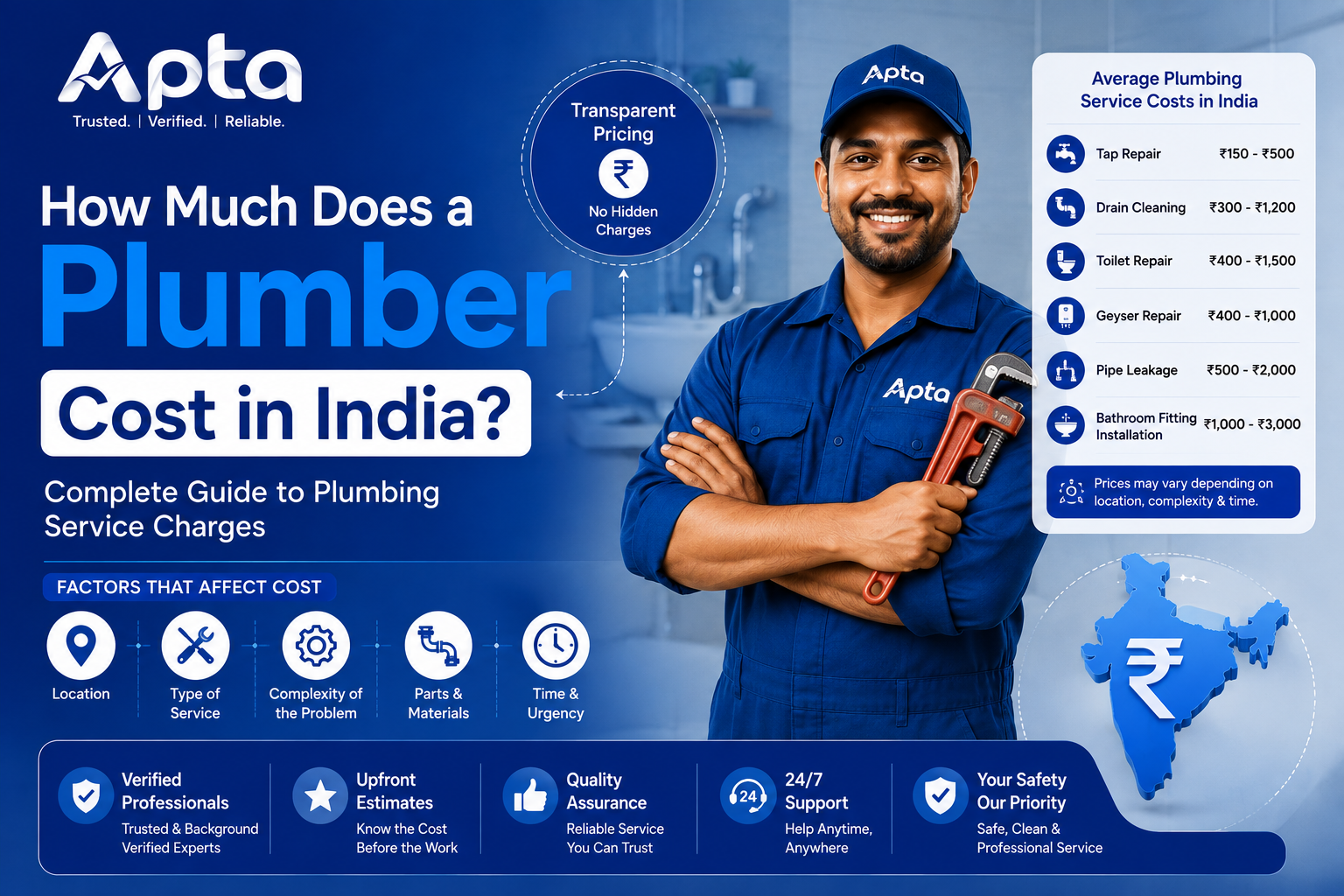
There is no single price for plumbing services across India.
The cost can vary depending on:
- City and locality
- Type of plumbing problem
- Labour required
- Replacement parts
- Emergency service
- Complexity of the job
- Professional experience
- Travel distance
- Time required
For this reason, customers should be careful with generic “fixed price” expectations.
For simple jobs, you can ask for an approximate price before the visit. For complicated repairs, the plumber may need to inspect the problem before providing a reliable estimate.
Plumber Near Me: Why Location Matters
When searching for a plumber near you, proximity can be particularly important for urgent problems.
A local professional may be able to:
- Reach your location faster
- Understand local service areas
- Provide repeat service more easily
- Reduce travel-related costs
- Respond more conveniently to emergencies
However, the nearest plumber isn’t automatically the best plumber.
Ideally, compare distance with experience, reviews, availability and trust information.
How to Compare Two Plumbers
Suppose you find two professionals.
| Factor | Plumber A | Plumber B |
|---|---|---|
| Distance | 2 km | 5 km |
| Experience | 3 years | 8 years |
| Rating | 4.8 | 4.7 |
| Reviews | 18 | 240 |
| Relevant skills | Basic | Strong match |
| Verification | Available | Available |
| Estimated price | ₹400 | ₹500 |
Which one should you choose?
There is no universal answer.
For a simple repair, Plumber A might be perfectly suitable.
For a complicated plumbing problem, Plumber B’s greater experience and larger review history may make the additional cost worthwhile.
The best professional is not necessarily the cheapest or closest. It is the one that best matches your requirement and gives you enough information to make a confident decision.
Red Flags to Watch Out For
Be cautious if a service professional:
- Refuses to discuss pricing at all
- Demands an unusually large advance without explanation
- Cannot explain the proposed repair
- Has repeated complaints about the same issue
- Pressures you into unnecessary work
- Changes the price significantly without discussing it
- Cannot provide basic information about their experience
- Becomes aggressive when you ask questions
- Wants to start major work without explaining the scope
One red flag doesn’t automatically prove that someone is dishonest, but several warning signs together should make you reconsider.
What Customers Should Do Before a Plumber Arrives
A little preparation can make the service easier.
Before the visit:
- Take photos or videos of the problem.
- Note when the problem started.
- Identify where the leak or blockage appears.
- Move valuables away from the affected area.
- Keep access to the plumbing area clear.
- Ask about the visit charge.
- Confirm the appointment.
Photos and videos can also help the professional understand the issue before arriving.
What to Do After the Repair
Once the work is completed:
Check the repair
Run the relevant tap, flush the toilet or test the repaired connection where appropriate.
Ask what was repaired
A good professional should be able to explain the work performed.
Keep the bill
Save the invoice or payment record, especially for expensive work.
Ask about warranty
If a part was replaced or major work was completed, ask whether there is any warranty.
Leave an honest review
Your review can help the next customer make a better decision.
Mention specific details such as:
- Quality of work
- Punctuality
- Behaviour
- Pricing
- Communication
- Whether the issue was resolved
Why Trust Matters When Hiring Local Professionals
A plumbing service isn’t only about fixing a pipe.
A professional may need to enter your home, interact with your family and handle valuable equipment or property.
That’s why service discovery should go beyond simply displaying a phone number.
Customers should be able to understand who the professional is, what they do, how experienced they are and what previous customers say about them.
This is where digital professional profiles can make local service discovery more transparent.
Finding Local Professionals Should Be Easier
Traditionally, people have found plumbers through neighbours, friends, local shops, newspaper advertisements or random internet searches.
These methods can work, but they often provide limited information.
A better service discovery experience should allow customers to compare professionals based on useful information such as:
- Skills
- Experience
- Reviews
- Ratings
- Location
- Availability
- Verification
- Previous work
- Service areas
- Communication options
The goal isn’t simply to find a plumber.
The goal is to find the right plumber for your requirement.
How Apta Can Help
Apta is being built around a simple idea: finding a local service professional should be easier and more trustworthy.
Instead of relying only on a phone number or a name, customers can discover professional profiles and evaluate important information before deciding who to contact.
Depending on the professional and service, this can include information such as experience, skills, ratings, reviews, service areas and verification details.
Apta is designed to help customers discover local professionals for everyday services while giving skilled professionals a digital identity and profile they can build over time.
Whether you need a plumber, electrician, carpenter, painter, appliance technician or another local professional, the same basic principle applies:
Know who you’re hiring before you hire them.
Final Checklist: Before Hiring a Plumber
Save this checklist for your next plumbing requirement:
☐ Check relevant experience
☐ Read customer reviews
☐ Check ratings
☐ Look for available verification information
☐ Confirm service area
☐ Ask about visit charges
☐ Request an estimate
☐ Confirm availability
☐ Ask about parts and materials
☐ Discuss warranty or workmanship guarantee
☐ Confirm the scope of work
☐ Keep payment records
☐ Leave an honest review
Frequently Asked Questions
How do I find a reliable plumber near me?
Search for plumbers who serve your locality and compare their experience, reviews, ratings, skills, availability, pricing and available verification information before making a decision.
What should I check before hiring a plumber?
Check relevant experience, customer reviews, service area, pricing, availability, skills and verification information. For larger jobs, also ask for a detailed estimate.
Should I choose the cheapest plumber?
Not necessarily. Compare the total value, including experience, reviews, quality of work, trust information and price.
How much does a plumber charge in India?
Plumbing charges vary depending on the location, type of repair, labour, parts, complexity and urgency. Ask for an estimate before approving the work.
How can I know whether a plumber is trustworthy?
Look for consistent customer reviews, relevant experience, clear communication and available identity or professional verification. Avoid relying on a single rating or badge.
Should I ask for a quote before plumbing work?
Yes. For simple jobs, ask for an approximate price. For complex work, request a detailed estimate covering labour, materials and additional charges where applicable.
Can I hire a plumber for an emergency?
Many plumbers provide emergency or same-day services, but availability varies by location and professional. Confirm response time and emergency charges before accepting the service.
Conclusion
Finding a plumber near you takes only a few seconds. Finding the right plumber requires a little more consideration.
Before hiring, look beyond price and proximity. Check experience, reviews, skills, availability, service area and verification information. Ask questions, understand the estimated cost and clearly discuss the work before it begins.
Most importantly, choose a professional based on the overall picture—not just a star rating or the lowest quote.
As local services become increasingly digital, customers should have better ways to discover, compare and connect with professionals they can feel confident hiring.
Because when someone enters your home to solve a problem, trust matters just as much as the repair itself.